Let’s clear this up.
If you’re a content creator, influencer, or building any kind of online income in the UK right now (April 2026), you’ve probably seen people saying you need a limited company to save tax or that all serious creators are limited.
But the reality is a bit different.
You don’t always need a limited company. In fact, for a lot of creators, it’s not the right move yet.
So let’s break it down simply. When you don’t need one, when you might, and what most influencers get wrong.
First things first: you’re already a business
If you’re getting paid for posts, earning from platforms like TikTok or YouTube, or working with brands, you’re already considered self-employed in the UK.
That means you need to track your income, you may need to register for Self Assessment, and whether it feels like it or not, you’re running a business.
So what is a limited company?
A limited company is a separate business entity from you personally.
Instead of everything sitting under your own name as a sole trader, the company earns the money, pays corporation tax, and then pays you.
It feels more official, which is why a lot of influencers start thinking about it early on.
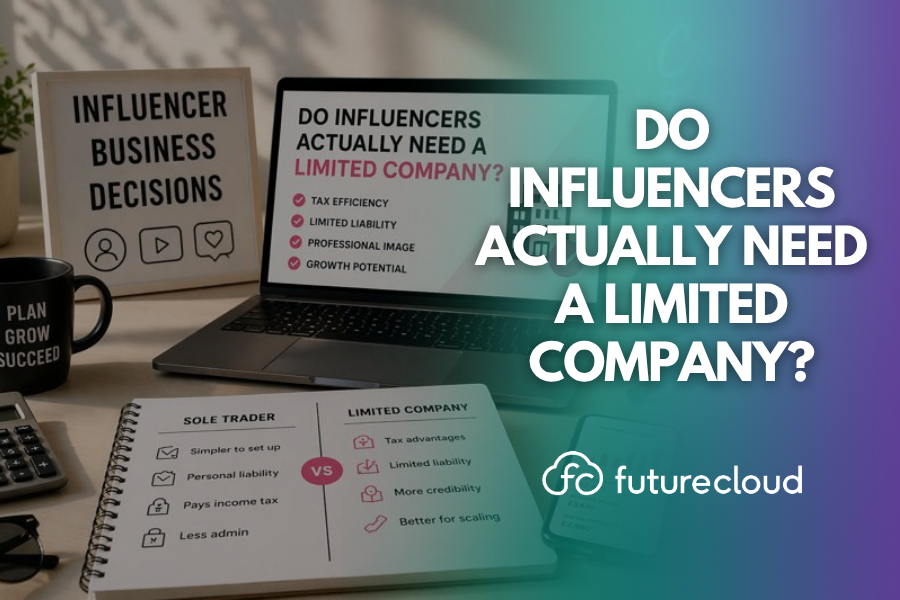
Do influencers need a limited company?
The honest answer is that most influencers don’t need one at the start.
If you’re just getting brand deals, earning inconsistently, or still growing your audience, staying as a sole trader is usually the better option. It’s simpler, cheaper, and involves far less admin.
When a limited company starts to make sense
Things start to change when your income becomes more consistent and starts to grow.
At that point, tax becomes a bigger factor. A limited company can be more tax efficient at higher profit levels, which is why many full-time creators eventually switch.
It also gives you more flexibility. As a sole trader, you pay income tax on all your profits. With a limited company, you can take a mix of salary and dividends and have more control over when you take money out.
There’s also a perception shift. Having a limited company can make you look more established when working with brands and agencies. It’s not essential, but it can help as you grow.
Another big benefit is separation. Your business money is separate from your personal money, which makes everything easier to track and manage. This is something many creators struggle with in the early stages.
And if you’re starting to take things seriously, signing contracts regularly or building a team around your content, a limited company begins to make more sense as part of that structure.
When you probably don’t need one yet
This is where most people get it wrong.
If your income is still low or inconsistent, if you’re testing content creation, or if you just want to keep things simple, then you probably don’t need a limited company yet.
Going limited adds responsibility, and that’s something a lot of creators underestimate.
The downsides no one talks about
A limited company sounds like the next step, but it comes with trade-offs.
There is more admin involved, including filing annual accounts and submitting information to Companies House. There are also higher costs, as most people will need an accountant once they go limited.
It’s also important to understand that company money is not your personal money. You can’t just move it freely without thinking about the tax implications, which can catch people out.
The biggest mistake influencers make
The most common mistake is setting up a limited company too early.
This usually happens because people see other creators doing it or hear advice online about saving tax.
What they don’t see is that those creators are often earning significantly more and are in a completely different position.
Setting up too early can add unnecessary costs, complicate your finances, and in some cases not actually save you any tax at all.
So, should you set one up?
The simplest way to think about it is based on where you are right now.
If your profits are still relatively low, your income isn’t consistent, and you want to keep things straightforward, staying as a sole trader makes sense.
If you’re earning higher profits consistently, thinking about tax efficiency, and building a long-term brand, then it may be time to consider a limited company.
Ready to Decide If a Limited Company Is Right for You?
If you’re earning through content creation and aren’t 100% sure whether you should stay as a sole trader or set up a limited company, now is the time to get clarity.
With the right advice and a solid structure in place, you can stay compliant, plan your tax properly, and build your creator business the right way from the start.
Get in touch with our team today to find out how we can support you.
Your friendly, forward-thinking accountants!
Want more advice and the latest accounting news?
Sign up to our monthly newsletter here. Especially useful for business owners.
And don’t forget to follow us on social media for the latest updates, tips, and more.